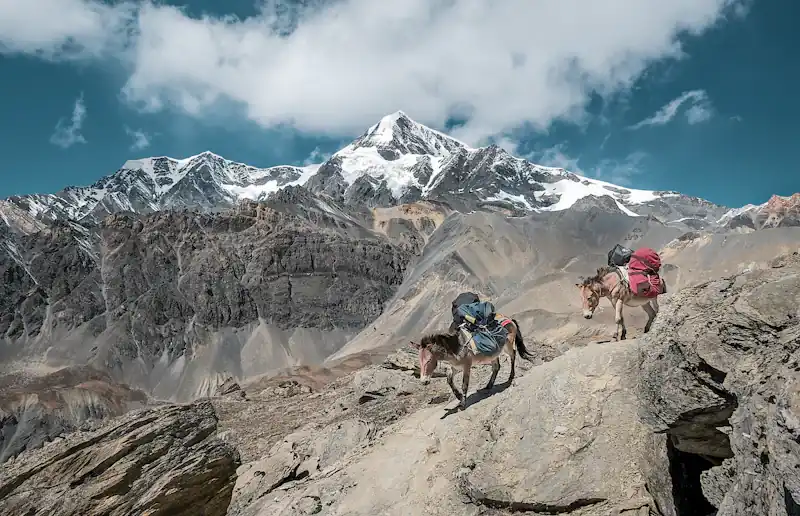
In the mountains you do not dress for one temperature. You dress for the whole day: a warm valley in the morning, a freezing pass at noon, a windy camp at night. The 3-layer system is how you cover all three without carrying a wardrobe.
The idea is simple. Wear several thin layers that you can add or remove, instead of one thick one.
The three layers
| Layer | What to wear | What it does |
|---|---|---|
| 1. Base | Merino wool or synthetic thermal top and bottom | Sits on the skin and moves sweat away so you stay dry |
| 2. Insulation | Fleece or light down or synthetic jacket | Traps warm air. Add or remove it as the temperature changes |
| 3. Shell | Windproof and waterproof jacket and trousers | Blocks wind, rain and snow. Wind chill is often the biggest danger |
Swipe the table sideways to see every column →
Add a heavy insulated jacket for stops, camp and cold mornings. You will not wear it while moving, but you will be glad you packed it the moment you stop.
Why cotton is dangerous
Cotton soaks up sweat and holds it against your skin. Wet cotton loses most of its insulation and dries very slowly, and in cold wind that can lead to hypothermia. Jeans, cotton hoodies and cotton socks are the usual culprits. Leave them at home or keep them for the hotel in Manali or Leh.
Choosing a down jacket
- Fill power measures how much loft the down has. 600 to 700 is excellent value. 800 and above is lighter and packs smaller but costs more.
- Down loses warmth when it gets wet. If you expect rain or snow, keep it inside a waterproof stuff sack, or choose a synthetic insulated jacket that keeps working when damp.
- Choose a jacket that fits over a fleece, with a hood that works with a helmet or beanie.
Hands, feet, head and eyes
- Feet: well broken-in, waterproof boots with ankle support. Take two or three pairs of wool or synthetic socks and rotate them. Never wear new boots on a trip.
- Hands: thin liner gloves under a warm outer glove or mitt. Riders need windproof gloves.
- Head and neck: a warm beanie, a buff or neck gaiter and a sun hat for the day.
- Eyes and skin: UV radiation increases by roughly 10% for every 1,000 m you climb, and snow reflects more. Carry sunglasses that block UV (with side protection if you can), SPF 50 sunscreen and lip balm.
Keep your batteries warm
Cold drains phone, camera and power-bank batteries quickly. Keep them in an inside pocket close to your body during the day, and in your sleeping bag at night. A phone that dies at 20% in the cold often revives once it warms up. Carry a power bank and spare camera batteries, and switch your phone to battery-saving mode in areas with no signal.
What changes by trip type
| Trip | Pay extra attention to |
|---|---|
| Trek | Boots, socks, rain shell, a warm sleeping layer, gaiters for scree, a headlamp with spare batteries |
| Road trip | Easy-to-reach layers in the car, a warm jacket for photo stops, a power bank, motion-sickness remedy if you need it |
| Bike ride | Armoured, windproof riding gear, a thermal layer under it, riding gloves and a spare pair, a rain cover for luggage |
Start a hike slightly cool. If you leave camp warm, you will be soaked in sweat 20 minutes later.
— Skypath Field NoteNot sure what to pack?
Tell us your trip and dates and we will send the gear list for that route and season.